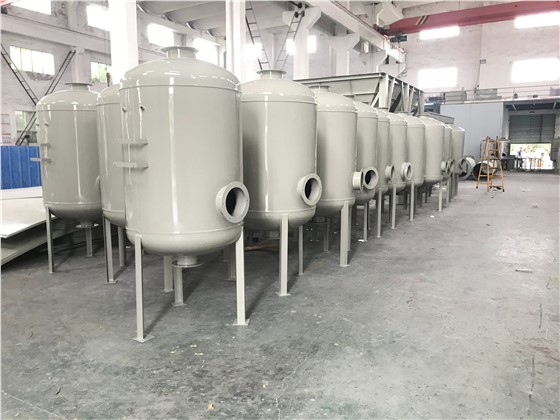
Silane (SiH4) Exhaust Gas Treatment SystemFor Shanghai Jiangwei Semiconductor Technology Co., Ltd.
Background & Challenge:
Silane (SiH4) exhaust treatment is not just a standard gas purification task — it involves simultaneous control of reaction safety, particulate generation, and system stability.
The client’s process presented several real engineering challenges:
1.Silane reacts rapidly, creating uncontrolled heat release and safety risks
2.Post-reaction generates ultra-fine SiO2particles, difficult to capture and prone to secondary pollution
3.Dust accumulation led to frequent blockage in conventional systems
4.Continuous operation required stable performance under fluctuating conditions
The key challenge was not just removal — but controlling the entire reaction-to-treatment process safely and continuously.
Solution Provided:
Chaori developed a process-integrated silane treatment system, focusing on controlling each stage of the gas transformation rather than relying on a single unit.
The design strategy included:
1.Front-end reaction control to stabilize silane conversion and avoid uncontrolled combustion
2.Stage-wise particulate management to prevent fine SiO2from accumulating or escaping
3.Process buffering design to reduce impact from load fluctuations
4.End-stage wet purification to ensure final emission stability
Instead of a single-step treatment, the system was engineered as a controlled transition from reactive gas → particulate phase → stabilized exhaust, ensuring each stage operates within a manageable range.
Key Engineering Strengths:
1.Reaction control capability rather than simple combustion design
2.Anti-clogging system logic, addressing particle behavior instead of only filtration
3.Process stability design for continuous semiconductor production conditions
4.Material and structure selection based on corrosive and reactive characteristics
5.Redundancy and safety integration for high-risk gas handling
Results & Benefits
1.Controlled and stable handling of high-risk silane gas
2.Significant reduction in particulate-related blockage issues
3.Smooth and continuous system operation
4.Reliable compliance with emission requirements
Conclusion
This project demonstrates Chaori’s capability not just in equipment supply, but in engineering complex exhaust processes.
By focusing on reaction control, particle management, and system stability, the solution delivers a reliable and scalable approach for silane exhaust treatment in semiconductor manufacturing.